A weekly revenue review for one property
Record room nights, room revenue and pickup by stay date. Use the worksheet to prepare one pricing or distribution decision.

Which numbers belong in a weekly hotel revenue review?
Use a row per stay date and one definition of room revenue and currency. Mark completed nights as actual and future dates as on the books. Keep the snapshot date for future stays and use the same definition of available rooms each week. If a room goes out of order, record how it was treated in the denominator so the comparison can be repeated. Separate restaurant charges from room revenue.
How do you calculate occupancy, ADR and RevPAR?
Occupancy is sold room nights divided by available room nights. Average daily rate (ADR) is room revenue divided by sold room nights. Revenue per available room (RevPAR) is room revenue divided by available room nights. Leave a metric blank if its denominator is zero. Divide weekly totals to get weekly ratios. For example, 80 rooms sold out of 100 available with $9,600 in room revenue gives 80% occupancy, $120 ADR and $96 RevPAR.
What does pickup tell you about a future date?
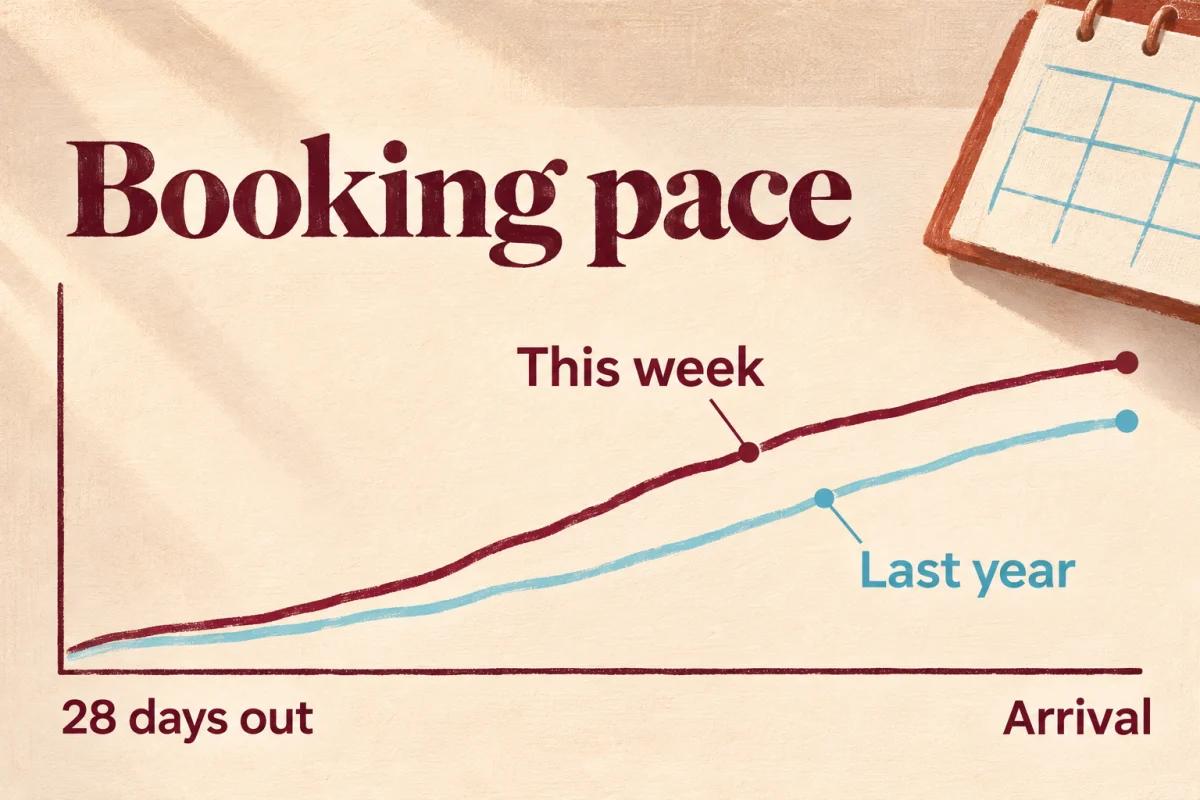
Compare the same stay date in two saved snapshots. A Saturday with 27 rooms on the books today and 19 in the prior snapshot has net pickup of eight room nights. The net calculation includes cancellations. Check booking changes by channel or room type if you need to explain what produced the movement. Compare different stay dates at similar lead times and keep the snapshot time consistent.
What should you check before changing a rate or restriction?
Look for changes in available rooms, a large group block or a channel closure before interpreting pickup as a demand signal. If Saturday gained eight rooms but six were a single group, compare the remaining bookings with similar Saturdays before changing the public rate. Write down the proposed change, which dates and room types it affects and when the decision can be reversed.
How do you follow up next week?
Use the worksheet’s decision, owner and review date columns. Attach the current snapshot and name the measure you will check, such as net pickup for the same room type or the cost of a particular offer. Record unusual closures and group movements alongside the result. If dinner charges were found missing, handle them in the folio review and keep the rooms-only revenue series comparable.
Continue with your team
- Folio calculator
Estimate the four-week value of missed restaurant charges.